
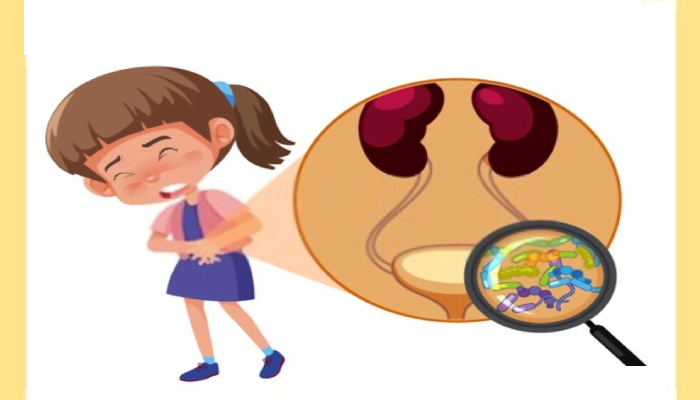
About urinary tract infections in children
Urinary tract infections (UTIs) in children are fairly common, but not usually serious. They can be effectively treated with antibiotics.
A UTI may be classed as either:
- an upper UTI – if it’s a kidney infection or an infection of the ureters, the tubes connecting the kidneys to the bladder
- a lower UTI – if it’s a bladder infection (cystitis) or an infection of the urethra, the tube that carries urine from the bladder out of the body
Symptoms of a UTI in children
It can be difficult to tell whether your child has a UTI, as the symptoms can be vague and young children can’t easily communicate how they feel.
General signs that may suggest your child is unwell include:
- a high temperature (fever)
- vomiting
- tiredness and lack of energy (lethargy)
- pain or a burning sensation when peeing
- needing to pee frequently
- pain in their tummy (abdomen), side or lower back
- blood in their pee
Diagnosing UTIs in children
In most cases, your GP can diagnose a UTI by asking about your child’s symptoms, examining them, and arranging for a sample of their pee to be tested.
Treatment usually begins soon after a urine sample has been taken, and your child won’t need any further tests.
In a few circumstances, further tests may be needed in hospital to check for abnormalities. Your GP may refer you straight to hospital if your child is very young.
Causes of UTIs in children
Most UTIs in children are caused by bacteria from the digestive system entering the urethra.
There are many ways this can happen, including:
- when a child wipes their bottom and soiled toilet paper comes into contact with their genitals – this is more of a problem for girls than boys because girls’ bottoms are much nearer the urethra
- babies getting small particles of poo in their urethra when they soil their nappies – particularly if they squirm a lot when being changed
Treating UTIs in children
Most childhood UTIs clear up within 24 to 48 hours of treatment with antibiotics and won’t cause any long-term problems.
In many cases, treatment involves your child taking a course of antibiotic tablets at home.
As a precaution, babies under three months old and children with more severe symptoms are usually admitted to hospital for a few days to receive antibiotics directly into a vein (intravenous antibiotics).
Conditions Treated
Doctors Availability
Dr. Geeta Kekre is attached with the different hospitals in Pune.
Call Us
You can make a call to Book an Appointment with Dr. Geeta Kekre the Best Paediatric Surgeon & Paediatric Urologist in Pune.
9619205178
Make an Appointment
Book an Appointment with Dr. Geeta Kekre she is the Best Paediatric Surgeon & Paediatric Urologist who specialises in Minimal Access Surgery for infants and children using Robotic surgery, Laparoscopy and Thoracoscopy in Pune.