

When a child needs surgery, it is natural for parents to feel worried. Questions like “Will my child have a lot of pain?”, “How long will recovery take?”, and “Will there be a big scar?” are common.
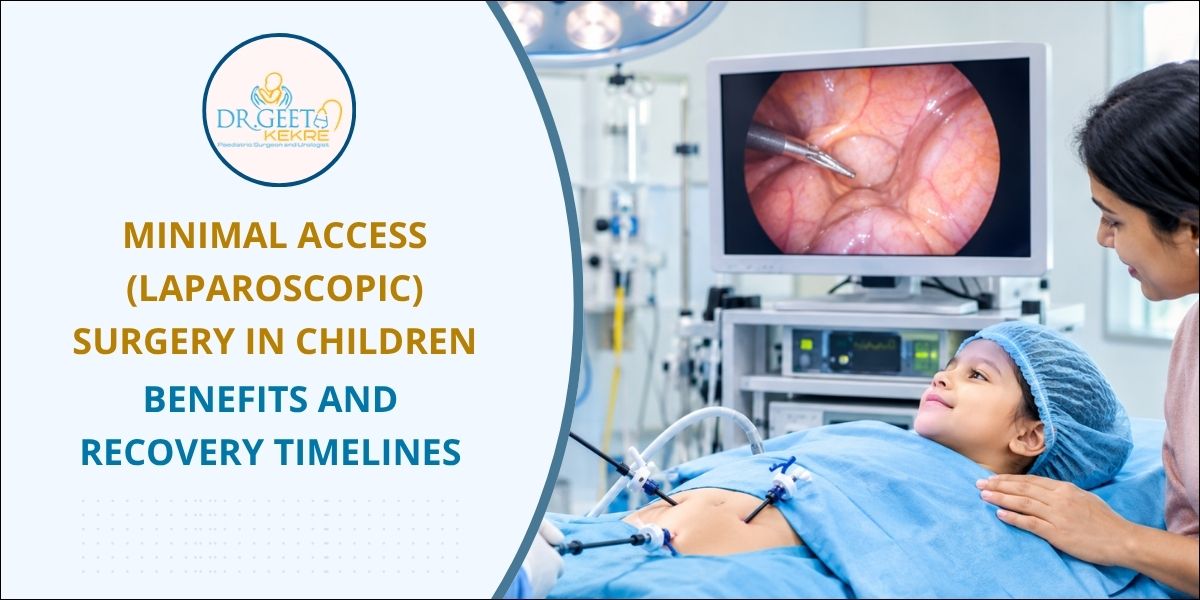
Fortunately, advances in pediatric surgery have made it possible to perform many procedures through minimal access surgery, also known as laparoscopic surgery. Instead of making one large incision, the surgeon uses a few small openings and a tiny camera to perform the procedure.
For selected children, laparoscopic surgery can offer smaller incisions, less discomfort after surgery, and a quicker return to normal activities. However, whether it is appropriate depends on the child’s age, medical condition, type of surgery, and the surgeon’s assessment.
What Is Minimal Access or Laparoscopic Surgery in Children?
Laparoscopic surgery is a minimally invasive surgical technique in which the surgeon makes small incisions rather than one large cut.
A thin instrument called a laparoscope, which has a small camera, is inserted through one of these openings. The camera allows the surgeon to view the inside of the abdomen on a monitor. Other small instruments can be inserted through additional openings to perform the surgery.
In children, laparoscopic techniques may be used for several procedures, depending on the condition and the child’s individual needs.
The main idea is simple: achieve the surgical goal while causing less disruption to the surrounding tissues.
What Are the Benefits of Laparoscopic Surgery for Children?
One of the biggest reasons parents ask about minimally invasive surgery is recovery. While every child is different, laparoscopic surgery may provide several potential benefits.
1. Smaller Incisions
Laparoscopic procedures usually require only a few small incisions. This means the wounds are generally smaller than those associated with traditional open surgery.
Smaller wounds can also mean smaller scars once they have healed.
2. Less Post-Surgery Discomfort
Because the incisions are smaller, some children may experience less discomfort after surgery compared with certain open procedures.
However, pain varies from child to child and depends on the type and extent of surgery. Doctors usually provide appropriate pain relief to keep the child comfortable during recovery.
3. Faster Return to Normal Activities
Children often recover quickly because of their natural healing ability. With minimally invasive surgery, some children may return to school and routine activities sooner than they would after comparable open surgery.
The exact timeline depends on the operation and the child’s recovery.
4. Shorter Hospital Stay in Some Cases
Depending on the procedure and the child’s condition, laparoscopic surgery may allow a shorter hospital stay.
Some procedures may even be performed as day-care or short-stay surgeries, while others require observation in the hospital for a longer period.
5. Smaller Scars
For many parents, scarring is an important consideration. Since laparoscopic surgery uses smaller incisions, the resulting scars are generally smaller.
It is important to remember that scars can look different depending on the child’s skin, age, healing process, and the procedure performed.
How Long Does a Child Take to Recover After Laparoscopic Surgery?
There is no single recovery timeline that applies to every child.
A child undergoing a relatively minor laparoscopic procedure may start walking and drinking fluids within hours, depending on the doctor’s instructions. Some children may go home the same day or the following day.
For more complex procedures, recovery may take longer.
A general recovery pattern may look like this:
First 24 hours:
The child may feel sleepy, tired, or mildly uncomfortable after anesthesia. Some children may experience temporary nausea or shoulder discomfort due to the gas used during certain laparoscopic procedures.
First few days:
Mild pain or soreness around the incision sites is common. Children may gradually resume normal eating, walking, and light activities as advised by their surgical team.
Within 1–2 weeks:
Many children undergoing uncomplicated procedures are able to return to school or regular daily activities during this period, depending on how they feel and the surgeon’s advice.
After a few weeks:
More strenuous activities, sports, swimming, or heavy physical activity may need to be restricted for a specific period. The surgeon will provide individual instructions.
These timelines are only general guidance. Always follow the recovery instructions provided by your child’s surgeon.
How Can Parents Help Their Child Recover?
Parents play an important role in helping children recover comfortably after surgery.
Make sure your child gets adequate rest and follows the prescribed medication schedule. Encourage fluids and normal meals as tolerated. Keep the surgical area clean and follow the wound-care instructions given by the medical team.
Children may feel anxious after surgery, so reassurance can also make a big difference. Explain what is happening in simple language and encourage gentle movement when permitted.
Do not rush your child back into sports or physically demanding activities. Even when a child appears completely fine, internal healing may still be taking place.
When Should Parents Contact the Doctor?
Some discomfort after surgery is expected, but parents should know what signs require medical attention.
Contact your child’s surgical team if there is persistent or increasing pain, fever, repeated vomiting, difficulty breathing, unusual swelling, redness or discharge from the incision, or if the child appears unusually unwell.
Your doctor can advise whether the symptoms are part of normal recovery or require an examination.
Is Laparoscopic Surgery Safe for Children?
Laparoscopic surgery is an established surgical approach and is performed in children for many conditions. However, no surgical procedure is completely risk-free.
The suitability of laparoscopic surgery depends on several factors, including the child’s age, diagnosis, previous surgeries, overall health, and the complexity of the procedure.
In some situations, open surgery may be more appropriate. The surgeon should discuss the available options, expected benefits, possible risks, and recovery process with the parents before surgery.
FAQs
1. Is laparoscopic surgery safe for children?
Yes, laparoscopic surgery is widely used in children when it is appropriate for their condition.
2. How long does a child take to recover from laparoscopic surgery?
Recovery varies by procedure, but many children resume normal activities within days to a few weeks.
3. Does laparoscopic surgery cause less pain?
Small incisions may reduce postoperative discomfort, although pain depends on the procedure and individual child.
4. Will laparoscopic surgery leave scars?
Yes, but the scars are usually smaller than those from comparable open surgery.
5. When can my child return to school after surgery?
Many children can return within 1–2 weeks after uncomplicated procedures, but the surgeon should give the final recommendation.