

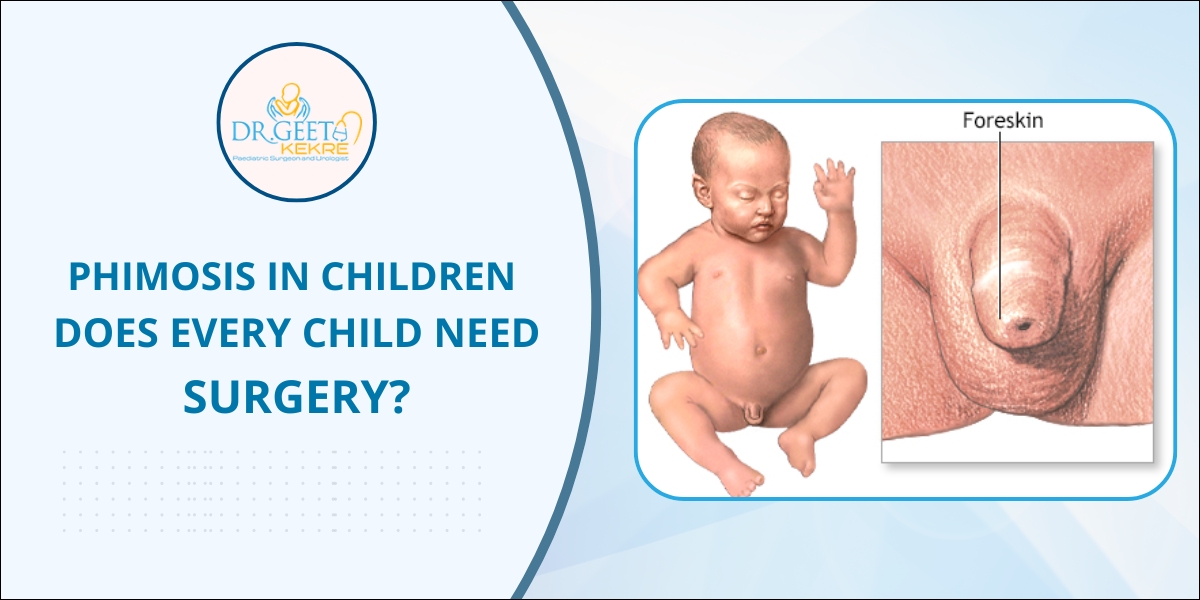
As a parent, it can be worrying to notice that your child’s foreskin does not retract. Many parents immediately wonder if surgery is necessary. The good news is that not every child with phimosis needs surgery. In many cases, it is a normal part of development and improves naturally as the child grows.
Understanding the difference between normal and problematic phimosis can help parents make informed decisions and avoid unnecessary treatments.
What Is Phimosis?
Phimosis is a condition where the foreskin cannot be pulled back over the head of the penis (glans). This is common in newborns and young boys because the foreskin is naturally attached to the glans at birth.
As children grow, the foreskin gradually becomes more flexible and separates on its own. By adolescence, most boys are able to retract their foreskin without any difficulty.
Is Phimosis Normal in Children?
Yes. Physiological phimosis is completely normal in infants and young children.
Parents should remember that:
- Most newborn boys have a non-retractable foreskin.
- Natural separation occurs gradually over several years.
- Forced retraction should never be attempted, as it can cause pain, bleeding, and scarring.
In many cases, patience and proper hygiene are all that is needed.
When Does Phimosis Become a Problem?
Not all cases are harmless. Sometimes, pathological phimosis develops due to scarring, repeated infections, or injury. Parents should consult a pediatric urologist if their child experiences:
1. Pain During Urination
Difficulty or pain while passing urine may indicate that the foreskin is too tight.
2. Ballooning of the Foreskin
A slight ballooning during urination can be normal in younger children, but persistent or severe ballooning should be evaluated.
3. Recurrent Infections
Repeated infections of the foreskin (balanitis) or urinary tract infections may require medical attention.
4. Bleeding or Scarring
Visible scarring or a white, hardened ring around the foreskin may suggest pathological phimosis.
Does Every Child Need Surgery?
The simple answer is No.
Most children with physiological phimosis do not require surgery. Doctors usually recommend conservative treatment first. Treatment options may include:
- Observation and regular follow-up
- Gentle foreskin care
- Prescription steroid creams that help loosen the foreskin
- Treatment of any underlying infection
Many children respond well to these non-surgical treatments.
When Is Surgery Recommended?
Surgery is considered only when conservative treatments fail or when complications develop.
A doctor may recommend surgery if the child has:
- Severe scarring of the foreskin
- Recurrent infections despite treatment
- Painful erections in older boys
- Difficulty passing urine
- Persistent pathological phimosis
Depending on the condition, the doctor may recommend circumcision or foreskin-preserving procedures.
How Is Phimosis Surgery Performed?
If surgery is needed, it is generally a safe and routine procedure performed under anesthesia. The child can usually return home the same day. Most children recover within one to two weeks with proper care. Parents are given instructions regarding:
- Hygiene
- Pain management
- Activity restrictions
- Follow-up visits
Can Phimosis Be Prevented?
Since physiological phimosis is a natural condition, it cannot be prevented. However, parents can reduce the risk of complications by:
- Avoiding forceful foreskin retraction
- Teaching proper genital hygiene as the child grows
- Seeking medical advice if infections occur
- Following the doctor’s recommendations for treatment
When Should Parents See a Doctor?
Consult a pediatric urologist if your child has:
- Pain while urinating
- Swelling or redness of the foreskin
- Repeated infections
- Blood or pus around the foreskin
- Difficulty emptying the bladder
- Persistent tight foreskin in older children
Early evaluation helps identify whether the condition is normal or requires treatment.
Phimosis is a common condition in children, and in most cases, it is a normal stage of development rather than a medical problem. Not every child needs surgery. Many children improve naturally with time, while others respond well to simple, non-surgical treatments such as topical steroid creams and proper foreskin care.
Surgery is reserved for children with persistent pathological phimosis, recurrent infections, significant scarring, or urinary problems. If you notice concerning symptoms, consult a qualified pediatric urologist for an accurate diagnosis and personalized treatment plan. Early medical guidance ensures your child receives the most appropriate care while avoiding unnecessary procedures.